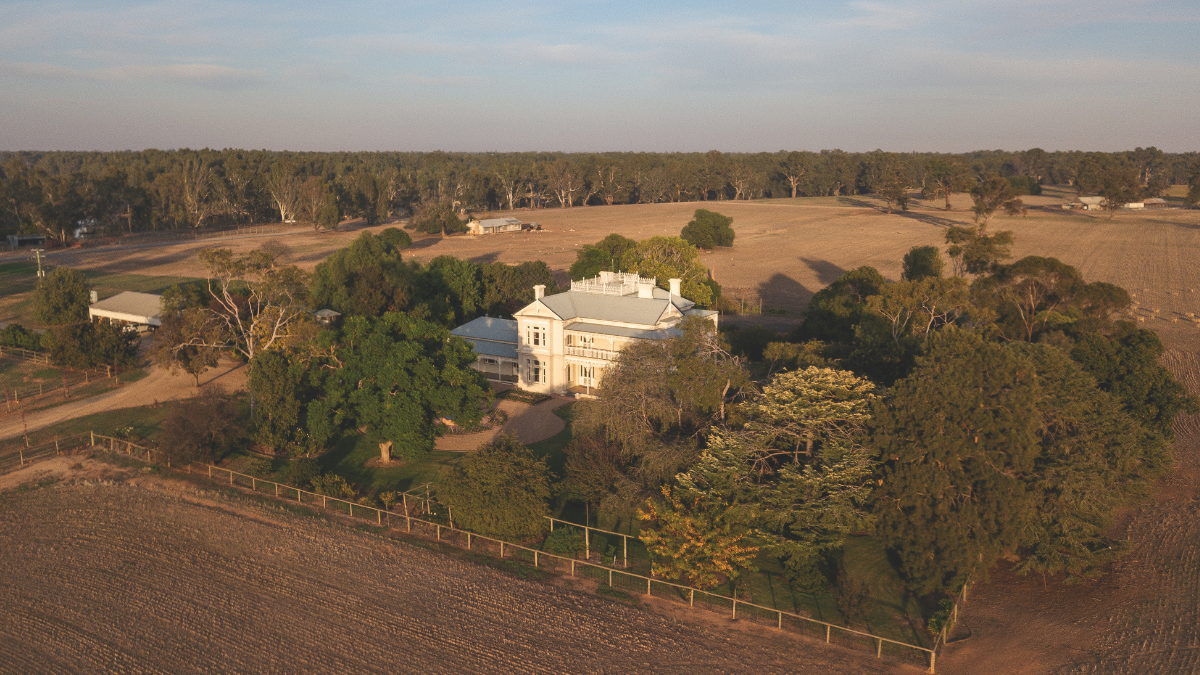
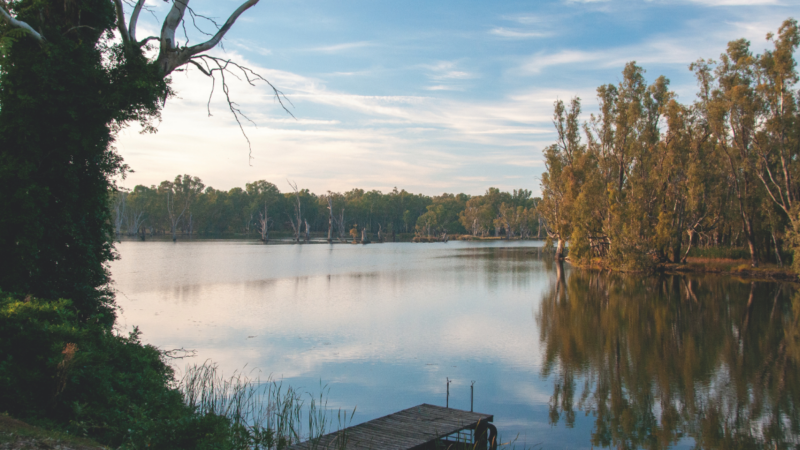
when long-time farmers Rodger and Kim Mathews bought Collendina, 20 kilometres west of Corowa on the Murray River, in 2012, they were more interested in the 3,200 acres (1290ha) of land and the 12km of prime Murray River frontage than the magnificent two-storey Victorian homestead.
However, they could not ignore the fact that they were the new owners of one of the most striking houses in southern New South Wales, described in the 1904 Cyclopaedia of Victoria as “… without a doubt one of the finest in the Riverina district. The extensive grounds are most beautifully laid out and kept in perfect order.” This description remains true today.
After farming, and raising their family, for 35 years on properties north of Corowa, the Mathews moved to Collendina soon after they took ownership. The following year they sold their other property interests.
“When we bought Collendina, the property hadn’t been farmed for some time,” Rodger says. “Thankfully, the water infrastructure was in reasonable condition. We needed to improve some fencing and alter paddock sizes to suit our farming plans. By planting the entire property with canola in our first year, we were able to get on top of the significant weed problem. The endless, rolling yellow paddocks that spring were magnificent.
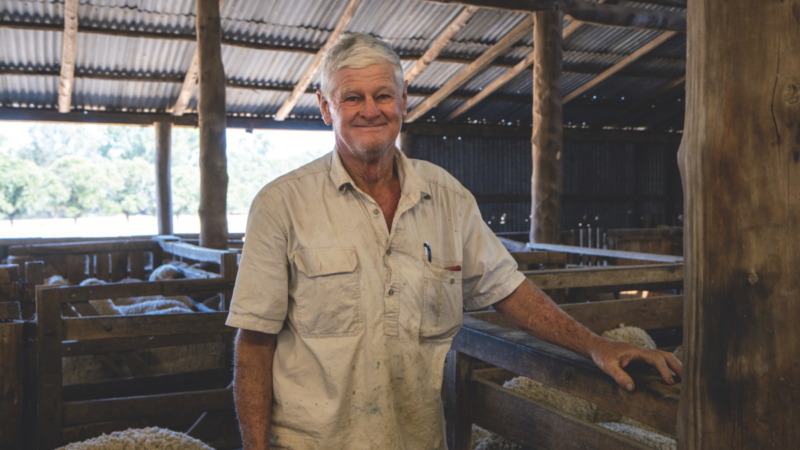
“Because there had been no crops planted for several years, the soil was ready for cropping with enough phosphorous and nitrogen. We were also very fortunate to have good rain that first year. We controlled the weeds and got rid of all the old timber in the paddocks. It was a significant cleanup effort. We see ourselves as lucky to own this property; however, we have worked hard and have been rewarded.”
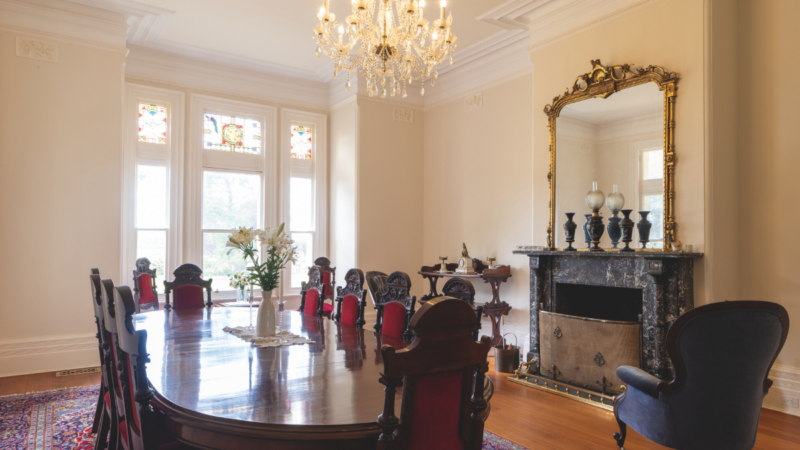
Maintaining the homestead and garden remains a big challenge for the family. “We have done a lot of work restoring the house; builders were working on restorations for three years before we moved in,” Kim says. “We continue to work on the garden, which has some beautiful old established trees including Chinese elms, cypress, eucalypts, jacaranda, cedars and native frangipani. We have a few projects planned for the garden and the propertyentry.”
The homestead was designed in 1891 by architect William Pitt, whose most prolific years, according to the Australian Dictionary of Biography, “… coincided with the boom period in Melbourne and his work, more than anyone else’s, reflected the confident exuberance of boomstyle architecture.”
Built under the critical eyes of its then owners, Henry Hay and his wife Christina, the house is constructed of solid brick, is cement-rendered, and comprises 30 rooms. It makes a statement in a region where such statements are not the norm. The home has a grand entrance leading to a striking dining room and drawing room, high ceilings, a sweeping staircase, stained-glass windows and a balcony bordered by intricate lacework on both levels. In the original design were two acres of lawn, a bowling green, a tennis court, an orangery, hundreds of rose bushes, and many ornamental trees and shrubs.
Early photos show the house sitting in the middle of a paddock, with not a tree in sight. Trees were eventually planted and the grounds laid out, which softened the homestead’s outlines. Fine views over the gardens and surrounding paddocks can be had from the roof, which is accessed via a narrow, steep staircase.
The homestead was reduced in size during the 1950s, when a double-storey wing was removed. Today, there are seven bedrooms, five bathrooms, a formal dining room, sitting room, office, and an open-plan kitchen and living room. The home is furnished with antique furniture sourced over the past 10 years, primarily from Valentine’s Antiques in Bendigo.
The original 12-stand woolshed on the property is still used, following adaptions over the past ten years. Its pens can hold 1000 mature sheep. Between the homestead and the river is a 15-metre red-brick water tower built by Chinese labourers following the gold boom. The iron tank at the top was filled with water from the lagoon via a diesel pump, then gravity-fed across the property.
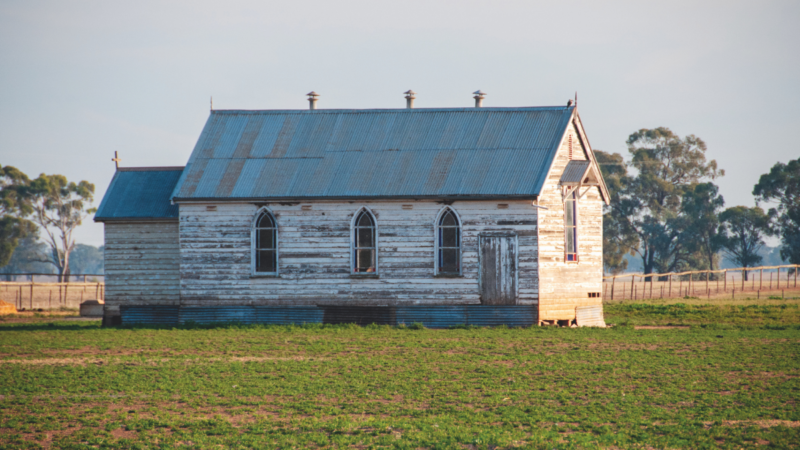
Celebrated painter Tom Roberts paid several visits to Collendina in the early 1890s. While staying there he painted a portrait of William Hay—Henry Hay’s father, which hangs today in the Murray Art Museum Albury. Roberts also painted the Old Barracks at Collendina, and in 1891 made a start on what would become one of his most celebrated works, A Break Away!, which shows a mob of thirsty sheep stampeding towards a dam despite the futile efforts of a drover to turn them around. The painting hangs in the Art Gallery of South Australia in Adelaide. A year earlier, Roberts painted his iconic Shearing the Rams at nearby Brocklesby.
The name William Hay looms large over both the Riverina and Collendina. Born in Scotland in 1816, Hay arrived in Australia in 1839 aged 23. Following seven years in Tasmania, Hay and his new wife, Jane, moved to Victoria and eventually built extensive land holdings in New South Wales, particularly along the Murray River between Barooga and Corowa. Among his purchases were the 50,000-acre (20,230ha) Collendina, which Hay bought in 1873, 30 years after it was first settled by Robert Brown, Boomanoomana 50km downriver from Collendina, Kunanadgee and Jillamatong.
Between 1872 and 1883 Hay was the member for Murray in the New South Wales Parliament. After he retired in 1886, he handed control and ownership of both Boomanoomana and Collendina to his sons, Alfred and Henry. The sons went their own ways, Alfred taking Boomanoomana and Henry Collendina, while their father moved to Melbourne where he became president of the Australian Club in William Street. He died in 1908 aged 92. Henry Hay reduced the size of Collendina to 23,000 acres (9310ha) of freehold land, which included 2,000 acres (810ha) of productive river flats. He substantially increased his carrying capacity by removing vast areas of grey and yellow box, pine and bull oak, and built stockyards, machinery sheds and the shearing shed.
Henry turned Collendina into one of the Riverina’s finest properties, renowned for the quality of its Merino sheep and shorthorn cattle, and was actively involved in the Corowa community. He was among the earliest graziers to recognise the value of fodder conservation to help in unproductive years. Collendina carried 32,000 sheep, with an average lambing percentage of 75 per cent. Henry worked to keep rabbits in check, netting the property, digging out their burrows and destroying ground cover.
Henry and Christina had six children, the eldest of whom, Henry Algernon — known as Algy — attended Cambridge University, graduating in law. Following Henry’s death in 1918, Algy took over the running of Collendina. This was hampered by the New South Wales Government’s decision to resume more than 10,000 acres (4050ha) of the property for soldier settlement following World War I. Algy eventually sold Collendina in 1924.
Algy’s younger son David, who was later knighted following a distinguished war record and a career in public service, including as ambassador to Thailand, ambassador to the United Nations and administrator of Papua New Guinea, wrote books about his great-grandfather, William Hay, and his upbringing at Collendina.
In From Collendina to Boomanoomana, Sir David wrote, “Sadly, by the early 1920s it must have been clear to Algy that Collendina was not generating enough income to enable all the family to live at the standard they had enjoyed for many years … [he] was always ready to try something new which would increase returns from the property. He introduced grapevines and also cotton but there was not time to determine whether they would be a success before Collendina had to be put on the market.”
The property was bought by the Carroll family, which held it for 50 years. Subsequent owners include the Howard and the Cranney families.
Since buying Collendina, the Mathews have ambitiously and steadily increased their holdings, buying four neighbouring properties, which were originally part of Collendina: Collerain (1350 acres, or 550ha), Red Acres (2000 acres, or 810ha), Inglebar (2400 acres, or 970ha) and Bulolo (900 acres, or 360ha). Collendina’s size has increased from 3240 acres (1310ha) to just under 10,000 acres (4050ha).
Today, more than half the property, 6000 acres (2430ha), is under wheat and canola, with a bit of barley thrown in. Collendina – the name means swirling waters in the language of the Bangarang people – has 750 acres (300ha) of islands on the Murray River, which come into their own when the river levels are at normal height and livestock can get access. Five centre-pivot irrigators spread water sourced from the Murray and bores over 535 acres (210ha), growing lucerne, cereal crops and corn. The rest is grazing land on which the Mathews run 2300 sheep, including 1800 stud Merino ewes, the centrepiece of their Borambil Merino and Poll Merino Stud. This stud was established by Rodger’s late father at Borambil near Balldale before being relocated to Collendina. The Mathews sell around 180 stud rams annually, primarily at auctions on Collendina.
“We are very lucky because we have good diversification to our farming enterprises, but we are always at the mercy of fluctuating markets,” Rodger says. “Farming always comes back to supply and demand. At the end of the day, farmers are price-takers, not price-makers. If you cannot handle the uncertainty and risk of that, you should not be in farming.”
Rising input costs at Collendina have seriously increased the costs of production, but machinery has made farming easier, despite the substantial cost. “We can achieve with three people what 20 would have been able to do 40 years ago; however, machinery costs, along with fertilisers, chemicals and freight, have doubled in the last five years. We also have to employ people capable of operating the machinery. I have no doubt that in ten or twenty years our machinery will be fully automated. Already GPS is making life so much easier.”
Long-term rainfall at Collendina is a reliable 560mm, mainly falling in the autumn, winter and spring. “Although a good season can mean good money, a drought is never far away; I have learned really not to worry about the weather,” Rodger says. “Although I look at a few weather forecasts, I am also happy to follow my instincts and look to nature. Fresh shoots on gum trees means rain is not far away. Like most things in life, there is a balance in nature that should not be ignored.”
Rodger and Kim have four children — Ben, Shayne, Luke and Nicole — and six grandchildren. All children have taken different paths. Ben, a successful AFL footballer, is currently assistant coach at the Sydney Swans. Shayne, an agricultural scientist, is an agronomist with a seed company and also farms his own land adjoining Collendina. Luke, an agricultural economist, worked in grain commodity trading and marketing for fifteen years before moving to Inglebar, and farms with Rodger and Kim at Collendina. Nicole is a pharmacist, who started her career locally in Corowa and currently works in rural Western Australia.
“We are aware of our good fortune to be able to live, work and enjoy time together on such a magnificent property as Collendina,” Nicole says. “We enjoy the river, the fishing, the farming, the space, the nature, and the beauty of our historic property, which we have made our home” AC