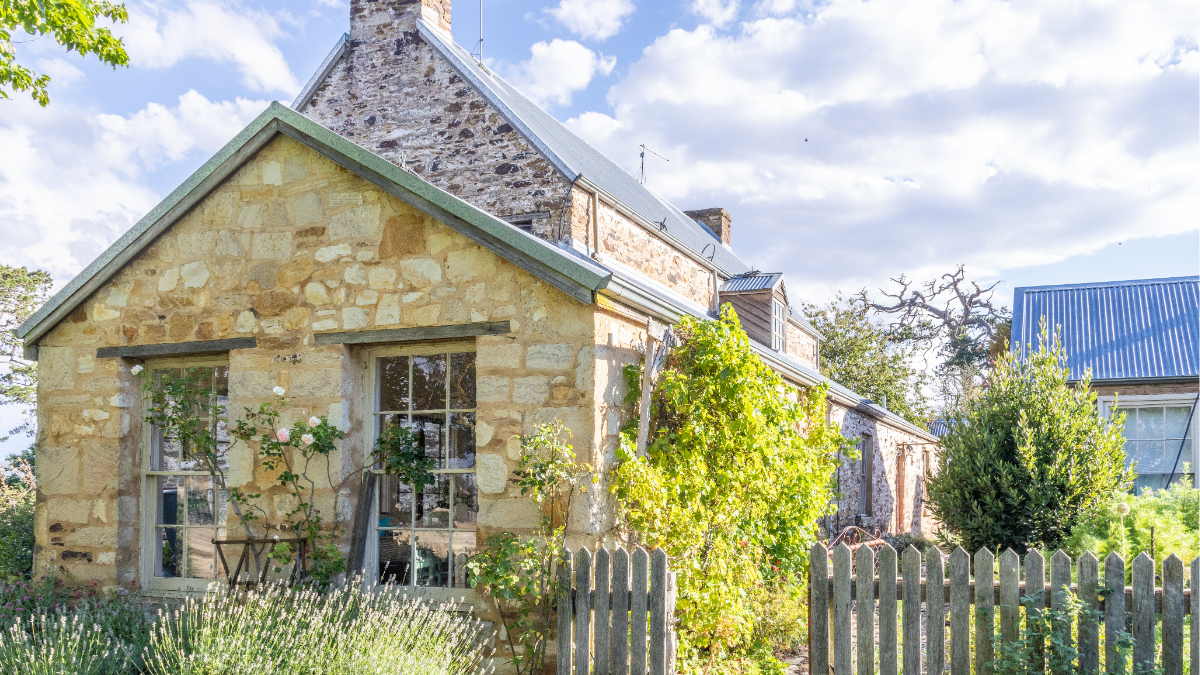
When Robbie and Peter Hoskins bought Longfield, their farm near Goulburn in the NSW Southern Tablelands in 1988, the 1850s homestead on the property was in complete disrepair, damaged by decades of vacancy and cattle taking shelter indoors.
The restoration of the house, built of stone transported by horse and cart from a quarry a few kilometres away using an unusual stone-layering technique to prevent rising damp, has been a work in progress ever since, with the Hoskins having worked tirelessly to give it new lease on life.
The first record of a purcase of land in the newly settled district of Thornford was in 1854 to William Folliard, who had migrated to Australia from what was then called Langfield in County Tyrone, Northern Ireland. He named the property Longfield for his family home. Although records of the early settlers of Goulburn are scant, it’s likely that a stone cottage in a courtyard at the back of the house, now known as the cookhouse, was built earlier and Folliard lived in it while he was building his two-storey stone house. The cookhouse was constructed from stones collected from the paddocks much closer to the site.
In 1888, Longfield was bought by Jacob Baxter and his wife, Rebecca, and the property remained in their family for almost a century. During their tenure, they pursued dairying initially and Baxter was involved in establishing the the Thornford Proprietary Ltd Butter Factory. After the great drought of 1902, he sold all his cows, and diversified into sheep and cattle. He added the slab stables and other outbuildings with a bough garage for his T Model Ford. Towards the end of the 19th century, the family of author Stella “Miles” Franklin lived next door at Stillwater, and Robbie likes to think the description of “Goulburn drowsing lazily in its dreamy graceful hollow in the blue distance” in Franklin’s My Brilliant Career approximates her own experience of living at Longfield nestled among the purple and blue hills of the Southern Tablelands.
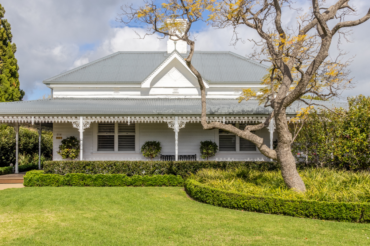
The homestead has been described as Georgian vernacular farmhouse with its mix of symmetrical facade and cedar joinery typical of the period as well as the practicality of its rural cottage character and separate cookhouse. As part of their restoration, Robbie and Peter added a conservatory-style sunroom and patio to the homestead, with guidance from Peter’s old school friend, architect Espie Dods.
Peter grew up on a dairy farm in the Goulburn region, while Robbie’s early years were on a station at Gindie, between Emerald and Springsure in Queensland’s Central Tablelands. Her father was an engineer working on surveys for the construction of the Fairbairn Dam where he met her mother, whose family owned a property that was partly resumed to build the dam. Robbie studied psychology at the University of New England and initially worked in Canberra, where she met Peter.
The Hoskins raised their three daughters, Rose, Airlie and Eve, at Longfield and these days, Airlie’s husband, Alex Downes, helps Peter on the farm, while Alex and Airlie run a small wedding and function venue on the farm. “We realised the potential when our daughters were married on the farm,” Robbie says. “Alex and Airlie were living and working in the Riverina and heard through friends that an old machinery shed and stables on the historic Tubbo station near Darlington Point were about to be pulled down.”
Alex was able to negotiate with the owners to buy the wonderful 150-year-old cypress pine buildings and resigned his job to spend the next six weeks dismantling and transporting the materials to reassemble them on Longfield as a beautiful rustic wedding venue. Couples usually opt to marry in the gardens surrounding the homestead, with a view across the countryside to the windmill and well that, in the 1860s, was described as a “never-failing well of water”.
In the early days, water from the well was hand-carried up to water the gardens, which was limited to essential fruit trees and vines, bay trees, pines and hedges. After a windmill and tanks were added, pumped water allowed a more ambitious garden that, by the 1920s and ’30s, included box topiary, tulips, roses, lilacs may, japonica, oleander, Japanese windflowers and snowdrops.
Since Robbie and Peter arrived, they have been grateful for Peter’s brother, landscape designer Jim Hoskins, who has given advice on restoring and saving the garden from its neglected state. “We decided to make the landscape the dominant feature,” Robbie says. “We made the bottom garden bed in front of the main house run the same way as the hills beyond to sit the garden in its Tablelands setting. The old garden crowded the house, so we’ve tried to give the home room to breathe by positioning most beds further away from the house.”
They’ve also tried to preserve as many old fruit trees as possible, including Kentish cherries, damson plums and a wonderful old apricot, which on whim occasionally delivers an abundance in summer. Other significant trees are Hawthorns and Osage oranges, originally planted as hedges, now so big that they shade the garden in summer.
Spring is the best time for flowers, while autumn is blessed with rolling mists, changing colours and “days so perfect we don’t want to leave for Easter”. Winter is when the old fruit trees are at their gnarly best and Peter is constantly feeding the Turkish boiler that heats the house with fuel of crushed olive pits.
Robbie adds that two solar-powered wells have allowed them more options than their predecessors when it comes to choice of plants. “Given the extremes of our climate, the focus is always on hardiness,” she says. “Some of the best performers come from slips from old Goulburn and Crookwell gardens. Many favourites came from Charlton, my mother-in-law’s garden. Others come from friends and fetes. All plants add history to a garden.”
Peter’s family includes many artists and the homestead is enhanced with works by both his parents and daughters. A piece by his father, Hugh, featuring green sheep features in a sitting room, while his mother, Sheila’s, paintings and sculptures are also displayed. Even though Sheila was legally blind, she continued to create works well into her 90s.
“The restoration has been a good challenge and it’s rewarding to see how it’s evolved,” Robbie says. “It’s also very rewarding to be able to share the setting for weddings and other gatherings.”