It is no accident that St Scholastica’s College year 11 student Lily Sampson and college executive member and head of Aboriginal education Lauren McFadden chose the courtyard at the campus entrance as the place to be photographed. Three flags — Australian, Aboriginal and Torres Strait Islander — fly proudly above the grassed area. It seems the perfect spot for Lauren, a proud Bidjigal woman, and Lily, a Wiradjuri and Gamilaroi student to discuss the school’s transformative approach to education for, and about, First Nations peoples.
St Scholastica’s, affectionately known as St Schol’s, has a long tradition of championing social justice for First Nations Peoples. The secondary day and boarding school for girls was established in 1878 by the Sisters of the Good Samaritan, Australia’s first congregation of religious women. Their order was founded on Benedictine principles of compassion for ‘‘the other’’ and community service, which included caring for disadvantaged and abused women in mid-19th-century Sydney. That continued into the 20th century, when the school moved to its present campus on the Toxteth Park Estate in the Inner West suburb of Glebe in 1901. Given its proximity to Redfern’s Aboriginal population, St Schols has long ties with that community, enhanced by decades of collaboration and tireless work to establish links and pathways for young First Nations women.
Among St Schol’s distinguished alumni are Senator Malarndirri McCarthy, class of 1988 and the school’s first Aboriginal captain, now the minister for Indigenous Australians in the Federal Parliament, and Yvonne Weldon AM, the City of Sydney’s first Aboriginal councillor. Given this history, it’s not surprising that St Schols can claim to be one of the state’s highest-performing schools in the Aboriginal Studies course.
In recent years, the school’s Higher School Certificate (HSC) achievements in Aboriginal Studies have included, in 2024, a student placing second in the state and 100 per cent of students achieving the top results of bands five and six. In 2022, a St Schol’s student, Santina Costanzo, placed first in the state. “Aboriginal Studies became a defining part of my senior years,” she says. “My major work on the criminal justice system strengthened my passion for advocating for change, and the subject helped shape my values, thinking and future direction. Now working at St Scholastica’s, I see every day how important it is for students to engage deeply with this learning. Aboriginal Studies is a subject that not only empowers students to succeed, but also fosters understanding, respect and real-world awareness.”
St Schol’s current enrolments are 1060 students, including 60 boarders. The school has 31 First Nations students, six of whom have chosen Aboriginal Studies as an elective. Offered to all students from Years 9 to 12, the Aboriginal Studies course this year has 32 students.
Lauren emphasises that Aboriginal Studies is a subject for all learners, not only First Nations students. She explains that learning about Australia’s First Nations histories, cultures and contemporary experiences is a shared responsibility. The course explores topics ranging from contact and colonisation to contemporary issues, cultural knowledge and community engagement, fostering deeper understanding, respect and connection across the student body.
She notes that truth-telling is an important part of the learning experience. “Learning about the past, and taking time to acknowledge it, helps us better understand where we are today,” Lauren explains. “While these conversations can be complex and sometimes challenging, they are meaningful and necessary, as they support deeper understanding and help us move forward together as a society.”
“I learn about culture, the frontier wars and things that weren’t taught in primary school,” says Lily, who moved with her parents from Dubbo to Sydney so she and her younger sister could take advantage of the opportunities St Schol’s offers. “It’s important to understand what’s going on in our community and how that affects your identity in Australia.”
During seven class contact hours per fortnight, the Aboriginal Studies students also take part in excursions to art galleries and museums. They were able to visit the University of Sydney on the momentous occasion of the return of the Gweagal spears taken by James Cook and Joseph Banks during the first contact in 1770 and finally repatriated by the UK’s Trinity College Cambridge 254 years later.
A recent school visit from former residents of Kinchela Boys Home Aboriginal Corporation allowed the students to hear first-hand the experience of stolen-generations survivors. “It’s important that survivors who were silenced for so long now have a voice,” Lauren says. “It’s part of their healing.”
Lily is currently conducting a Year 11 comparative study on Aboriginal and First Nations people in Canada. She is looking forward to working with her community as part of her major project in Year 12. It will involve interviews with her own community back in Dubbo, her father’s Gamilaroi community in Coonamble and a comparison with the lived experience of First Nations people of Canada. It’s early days of her comparative study, but she is looking forward to the challenges of primary research and the conclusions it may lead to. While she’s unsure of her future career, university is definitely on the horizon.
“St Schol’s has opened doors for me,” Lily says. “From the moment I walked in, everyone was welcoming. It’s given me the opportunity to take up sports like dragon boat racing and I’m lucky enough to have travelled for competitions. I am very excited to have been selected as part of the national team competing in Taiwan later this year.”
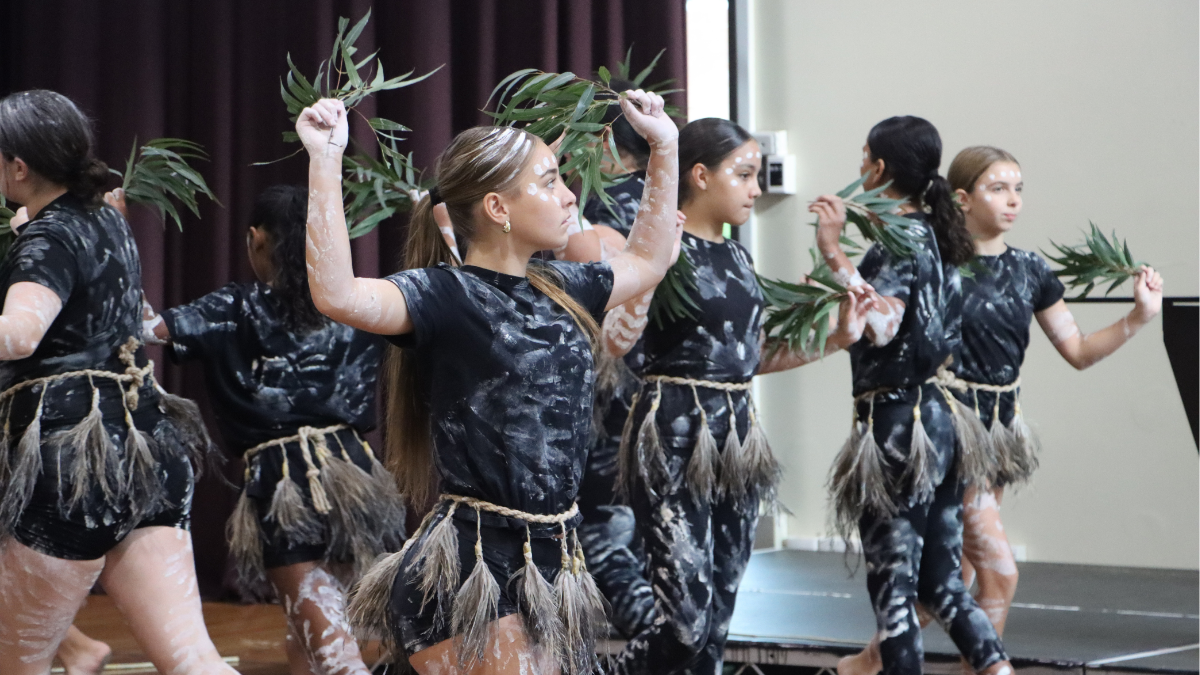
Lily adds that she values the range of co-curricular opportunities the school offers to support student engagement and cultural connection. She highlights the First Nations dance group, Miyaymiyaay, as a particularly meaningful experience. In addition, Lauren facilitates a yarning circle during lunchtimes, creating a space for conversation, reflection and community. Lily also notes that students have a strong voice in shaping the school’s NAIDOC Week program, as well as commemorative events such as Sorry Day.
“It’s important that as future leaders, our students take ownership of programs like this,” Lauren says. “I’m very proud of the programs that we have here, and students’ families and communities can also be proud of what their young women are achieving.” AC